
All Over The Place and in Full Color
- Lina Tjarks

- Dec 9, 2024
- 5 min read
A Story About the Art of Being Yourself - Unapologetically

What pronouns do you prefer?
"I don't care, but most people say 'she'. Anyway, you can't offend me. That's the good thing."
Are you sure?
"Try me."
What may first seem like people-pleasing or even bluntness is actually Jo Antunes' (22) general attitude of complete unconcern with societal expectations.
We're walking through a maze of corridors in Groningen's Minerva Academy, but Jo, with short and determined steps, knows exactly where she's going. We pass different workshops, art studios and classrooms, Jo greeting everyone, peers, teachers and maintenance workers as we go. Minerva is her safe place, as she calls it. A home away from home. And considering her background, it's exactly what she came to Groningen looking for.
****
When Jo was 12 years old, she moved to Dubai with her two older brothers and her parents. In Portugal, where she was born and raised, her father had to work five jobs, and her mother two just to keep the family afloat. "Dubai was a complete culture shock," she says. "Coming from a simple life in the countryside to this dystopian city." But she has good memories of the six years she spent there. "People that I talk to about the Middle East assume, especially because I'm queer, that I only had bad experiences. But my time there taught me a lot," she says. It's there she met some of her closest friends although most came from outside the country."It's almost like a contract," Jo says. "You are allowed to stay, get a good education, make a lot of money and live well, as long as you have your work visa. Essentially, you're a visitor."
Jo's parents still live in Dubai, and her brother plans to move there again for work. Jo understands why with experiences affecting people differently, depending on who you are, how you're perceived and why. "My brothers, they have the best time in Dubai, I mean, it’s a country literally made for white, straight men with money."
Would she ever consider living there again? "No, it's too dangerous. People like me can end up in prison." She snaps her fingers. "Just like that."

Homosexuality is a crime in the UAE, and public displays of queerness are criminalized. Charges can range from 10 years in prison, fines, deportation and even the death penalty. And Jo has first-hand experience of how quickly it can go - the parents of her first girlfriend nearly reported her to the police when they learnt about the relationship through leaked pictures of the couple.
Does she ever talk to her family about her not coming back? Almost every time she visits. "I think they're very, very nice people, but they still have blinkers on, and they have to live in a country like that." Over the years they've come to a mutual agreement. "I can accept that they live there, and they can accept that I don't want to go there," Jo says.
"Ignorance is bliss, and to live in a country like that, ignorance has to be the bliss. Because if you know what the hell is happening in the background, you're either a really bad person and don't care, or you just choose to ignore it." It's an approach to seeing the world that can bring its challenges. "It's one of my talents because that's what I do as an artist; I see things for what they are. But then it's literally a curse because I can't ignore a lot of things.”
Within the first year of living in the Netherlands, Jo went from wearing her school uniform each day to finding her own style. She cut her waist-long, pin-straight hair short, displaying her natural curls. The traditional use of henna back in the UAE, she then used to paint semi-permanent face and neck tattoos. She also started to learn more about her gender identity. When she went to see her family at the end of her first uni year, she had some explaining to do: "My parents were like, what the hell happened to you? I was like, yeah, Netherlands…”
****
With a loud smack, the art portfolio lands on the canteen table. The folder is half Jo's size, the past three years squeezed into one space. Almost. "Nooo, I forgot some pieces I was working on at home. My cat hid in my bag, and I didn't want to disturb him." Still, there are dozens of paintings, prints, collages and drawings on loose paper to look at, all stacked and sticking on top of each other. Some are experimental sketches; others are carefully thought-out ideas translated into different materials, mediums and colors.


A peek into Jo’s art portfolio - Portuguese tiles and fish prints, next to self studies on identity © Lina Tjarks
Jo's art draws from different experiences growing up. For the first year in Dubai, she didn't speak English and couldn't communicate with anyone at school. That's when she immersed herself in creating digital art on her iPad. What started as a way to keep occupied during class time is now her choice of self-expression. "My emotions are really loud, so I have to be able to portray them because I don't express them elsewhere," she says.
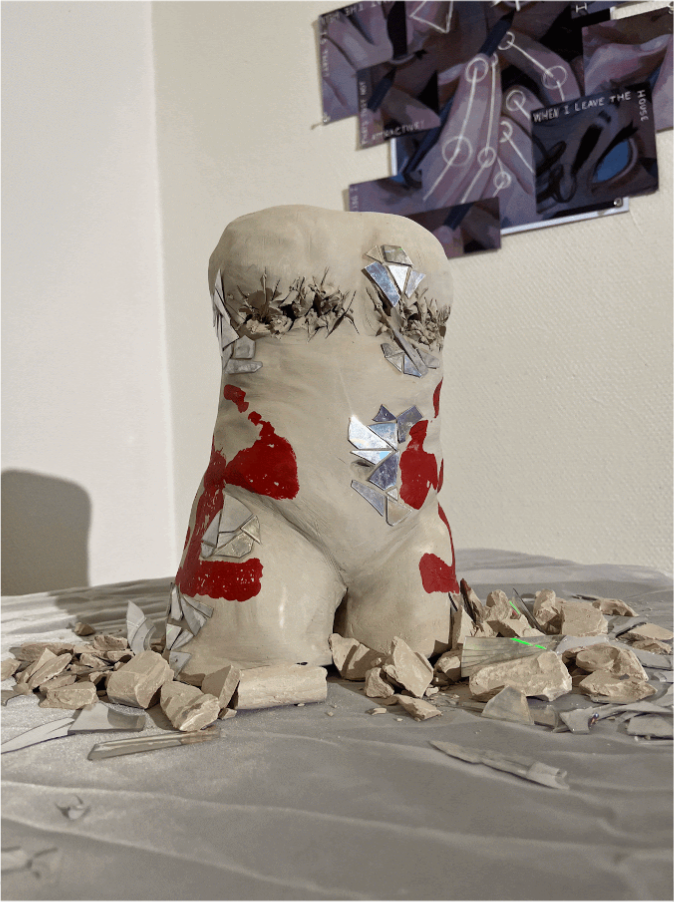
Now, her art shows different realities, and one's place in a society created by you but not for you. She shows how the neurodivergent can be seen as the norm when stepping away from external, conforming pressures. Almost every piece contextualizes the relationship between the individual and society. It's about perception and expectation, community and belongingness - what makes people human.

Together with a group of young artists from different creative backgrounds, Jo's working on a comic from and for the queer community. For her, the authenticity of experiences is one of the key elements in the creation process, and with this in mind the group's planning an immersive experience where other queer people that are not men talk about their experiences in a safe, anonymous space. Not many comics represent queerness, but there are even fewer actually made by queer people, especially queer, non-binary people or women. "There's a lot of media made for gay men because men just unfortunately have a lot of influence in this world. So in the queer community, especially for trans people, there's nothing out there," Jo says.
Jo believes that one of the reasons why it took her as long as it did to realize she does not necessarily identify as a girl is because there was no figure of identification for non-binary people. "There's not a lot of people who feel the same thing as you, have the same struggles as you, and that can be really hard."
The group plans on making kid-friendly illustrations that talk about queer experiences without it being the main storyline or reinforcing the sexualisation of queer people. The hero, Blue, is going through a process of discovery. "There's going to be love interests, but we don't want to make that the focus," Jo says. It's more about the little things and parts of queerness that nobody talks about.

"Even though you can clearly tell that I'm queer by looking at me - and it's the question that I get the most - it's not something that I try to do in my art all the time. But it's something that I know people like to listen to for me. Because of all the LGBTQ letters, I'm a lot of them. They take my opinion very seriously, so I feel like if you have the power, you have to use it, or you're just wasting it."
While Jo does not want her queerness to define her art, she acknowledges that it is part of her identity and will always be part of her creative process. In the case of Blue and the comic, she uses all her experiences to create the hero she did not see growing up.
Ultimately, the process of making her art allows Jo to understand the world around her. Her creations take you on a journey of exploration and finding belongingness. And by expressing herself in pieces, Jo creates spaces for people who do not fit the mould.


Comments